Thursday, 4 April 2024

'Cicada-geddon' Is The Biggest Bug Emergence In Centuries


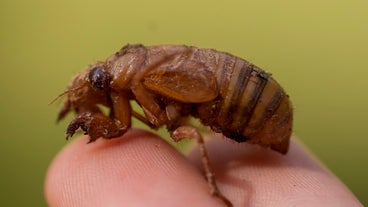
Trillions of evolution’s bizarro wonders, red-eyed periodical cicadas that have pumps in their heads and jet-like muscles in their rears, are about to emerge in numbers not seen in decades and possibly centuries.

Crawling out from underground every 13 or 17 years, with a collective song as loud as jet engines, the periodical cicadas are nature’s kings of the calendar.

These black bugs with bulging eyes differ from their greener-tinged cousins that come out annually. They stay buried year after year, until they surface and take over a landscape, covering houses with shed exoskeletons and making the ground crunchy.

This spring, an unusual cicada double dose is about to invade a couple parts of the United States in what University of Connecticut cicada expert John Cooley called “cicada-geddon.” The last time these two broods came out together in 1803 Thomas Jefferson, who wrote about cicadas in his Garden Book but mistakenly called them locusts, was president.

“Periodic cicadas don’t do subtle,” Cooley said.

If you’re fascinated by the upcoming solar eclipse, the cicadas are weirder and bigger, said Georgia Tech biophysicist Saad Bhamla.

“We’ve got trillions of these amazing living organisms come out of the Earth, climb up on trees and it’s just a unique experience, a sight to behold,” Bhamla said. “It’s like an entire alien species living underneath our feet and then some prime number years they come out to say hello.”

At times mistaken for voracious and unrelated locusts, periodical cicadas are more annoying rather than causing biblical economic damage. They can hurt young trees and some fruit crops, but it’s not widespread and can be prevented.

The largest geographic brood in the nation ― called Brood XIX and coming out every 13 years ― is about to march through the Southeast, having already created countless boreholes in the red Georgia clay. It’s a sure sign of the coming cicada occupation. They emerge when the ground warms to 64 degrees (17.8 degrees Celsius), which is happening earlier than it used to because of climate change, entomologists said. The bugs are brown at first but darken as they mature.

Soon after the insects appear in large numbers in Georgia and the rest of the Southeast, cicada cousins that come out every 17 years will inundate Illinois. They are Brood XIII.

“You’ve got one very widely distributed brood in Brood XIX, but you have a very dense historically abundant brood in the Midwest, your Brood XIII,” said University of Maryland entomologist Mike Raupp.

“And when you put those two together… you would have more than anywhere else any other time,” University of Maryland entomologist Paula Shrewsbury said.

These hideaway cicadas are found only in the eastern United States and a few tiny other places. There are 15 different broods that come out every few years, on 17- and 13-year cycles. These two broods may actually overlap — but probably not interbreed — in a small area near central Illinois, entomologists said.

The numbers that will come out this year – averaging around 1 million per acre over hundreds of millions of acres across 16 states – are mind-boggling. Easily hundreds of trillions, maybe quadrillions, Cooley said.

An even bigger adjacent joint emergence will be when the two largest broods, XIX and XIV, come out together in 2076, Cooley said: “That is the cicada-palooza.”

The origin of some of the astronomical cicada numbers can likely be traced to evolution, Cooley and several other entomologists said. Fat, slow and tasty, periodical cicadas make ideal meals for birds, said Raupp, who eats them himself. (His school put out a cicada cookbook called “Cicada-Licious.” ) But there are too many for them to be eaten to extinction, he said.

“Birds everywhere will feast. Their bellies will be full and once again the cicadas will emerge triumphant,” Raupp said.

The other way cicadas use numbers, or math, is in their cycles. They stay underground either 13 or 17 years, both prime numbers. Those big and odd numbers are likely an evolutionary trick to keep predators from relying on a predictable emergence.

The cicadas can cause problems for young trees and nurseries when their mating and nesting weighs down and breaks branches, Shrewsbury said.

Periodical cicadas look for vegetation surrounding mature trees, where they can mate and lay eggs and then go underground to feast on the roots, said Mount St. Joseph University biologist Gene Kritsky, a cicada expert who wrote a book on this year’s dual emergence. That makes American suburbia “periodical cicada heaven,” he said.

It can be hard on the eardrums when all those cicadas get together in those trees and start chorusing. It’s like a singles bar with the males singing to attract mates, with each species having its own mating call.

“The whole tree is screaming,” said Kritsky, who created a Cicada Safari app to track where the cicadas are.

Cooley takes hearing protection because it can get so intense.

“It’s up in the 110 decibel range,” Cooley said. “It’d be like putting your head next to a jet. It is painful.”

The courtship is something to watch, Kritsky imitated the male singing “ffaairro (his pitch rising), ffaairro.”

“She flicks her wings,” Kritsky narrated in a play-by-play. “He moves closer. He sings. She flicks her wings. When he gets really close, he doesn’t have a gap, he’ll go ffaairro, ffaairro, ffaairro, fffaairo.”

Then the mating is consummated, with the female laying eggs in a groove in a tree branch. The cicada nymph will fall to the ground, then dig underground to get to the roots of a tree.

Cicadas are strange in that they feed on the tree’s xylem, which carry water and some nutrients. The pressure inside the xylem is lower than outside, but a pump in the cicada’s head allows the bug to get fluid that it otherwise wouldn’t be able to get out of the tree, said Carrie Deans, a University of Alabama Huntsville entomologist.

The cicada gets so much fluid that it has a lot of liquid waste to get rid of. It does so thanks to a special muscle that creates a jet of urine that flows faster than in most any other animal, said Georgia Tech’s Bhamla.

In Macon, Georgia, T.J. Rauls was planting roses and holly this week when he came across a cicada while digging. A neighbor had already posted an image of an early-emerging critter.

Rauls named his own bug “Bobby” and said he’s looking forward to more to come.

“I think it will be an exciting thing,” Rauls said. “It will be bewildering with all their noises.”

___

Carolyn Kaster contributed from Macon, Georgia.

___

Read more of AP’s climate coverage at http://www.apnews.com/climate-and-environment

___

Follow Seth Borenstein on X at @borenbears

______

The Associated Press’ climate and environmental coverage receives financial support from multiple private foundations. AP is solely responsible for all content. Find AP’s standards for working with philanthropies, a list of supporters and funded coverage areas at AP.org.


Source: https://www.huffpost.com/entry/bc-cicadas-invasion_n_660acfaae4b0c4621eb7d244 ... and provided by video-cutter-online.com
There is new cut-trim tool cut-trim.com where you can cut-trim audio and video and convert mp3 to youtube cut-trim

Oregon Man Narrowly Escapes Being Gored By Runaway Saw Blade


A man in Eugene, Oregon, is thanking his lucky stars after narrowly escaping being gored by a runaway saw blade on Thursday. (Watch the video below.)

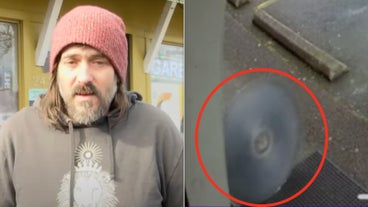
Shane Reimche was entering a local market when a 4-foot saw blade running at a nearby construction site came loose and hurtled toward the store’s front door.

“I was walking into the store here, I put my hand on the door and I heard a loud bang and yelling,” Reimche told Eugene ABC affiliate KEZI TV. “Just as a cloud of smoke pops up and I see a guy fall in the ditch. And a 4-foot blade hurtling at me.”

The errant saw blade ended up lodged in the store wall just inches from where Reimche just stood.

The building felt the impact, store owner Amit Grewal said.

“We were standing behind the counter. All I heard was metal rolling down the street,” he said. “It was just wind. All of a sudden we heard a loud bang. It shook the whole store.”

The saw blade was wedged 2 feet into the store’s wall and required three men to remove it, according to People.

A contractor at the construction site told KEZI that workers were fixing a leaky gas valve, and suggested operator error caused the blade to spin out of control.

A communications director from Northwest Natural Gas told the station that the incident “involved a contractor at a NW Natural job site,” and said that contractor has been removed from other work for the company while the incident is reviewed.

Meanwhile, Reimche was still shaken up about the incident when interviewed Friday.

“Oh my god, I had tears all night. It was petrifying. I was shaking in the store,” he told KEZI. “Took a little while before I could talk. That thing was huge. You can see the hole in the wall.”

His kids were also shocked when they saw the video and “they all came to my house and hugged me and had lots of cries.”

He added: “Obviously it wasn’t my time but probably closest I’ve ever experienced.”

Reimche then suggested how he was going to deal with the freak accident.

“I need a beer. I’m still shaken,” he said. “It’s 9 o’clock. I’m not going to work today.”


Source: https://www.huffpost.com/entry/shane-reimche-saw-blade-oregon-accident_n_660b02a8e4b0c4621eb7ea7e ... and provided by video-cutter-online.com
There is new cut-trim tool cut-trim.com where you can cut-trim audio and video and convert mp3 to youtube cut-trim

Central Thai City Aims To Put An End To Monkey Mayhem


BANGKOK (AP) — Thai wildlife officials laid out a plan on Wednesday to bring peace to a central Thai city after at least a decade of human-monkey conflict.

The macaques that roam Lopburi are a symbol of local culture, and a major tourist draw. But after years of dangerous encounters with residents and visitors and several failed attempts to bring peace with population controls, local people and businesses have had enough.

The monkeys frequently try to snatch food from humans, sometimes resulting in tussles that can leave people with scratches and other injuries. But outrage grew in March when a woman dislocated her knee after a monkey pulled her off her feet in an effort to grab food, and another man was knocked off a motorcycle by a hungry monkey.

Authorities hope to round up some 2,500 urban monkeys and place them in massive enclosures, said Athapol Charoenshunsa, the director-general of the Department of National Parks, Wildlife and Plant Conservation. They’ll work with wildlife experts to find a way for a limited number of monkeys to stay at liberty in the city, he added.

“I don’t want humans to have to hurt monkeys, and I don’t want monkeys to have to hurt humans,” he told reporters during a news conference in Bangkok.

An official monkey catching campaign was launched week, prioritizing more aggressive alpha males. It has caught 37 monkeys so far, most of whom have been placed put under the care of wildlife authorities in the neighboring province of Saraburi, while others were sent to the Lopburi zoo.

Officials said they plan to capture the rest of the monkeys once the enclosures are complete, especially those in the residential areas. Separate cages will be prepared for different troops of monkeys to prevent them from fighting.

Athapol said he expects the first phase of the operation to start within weeks, and believes the huge cages will be able to contain thousands of them and “will solve the problem very quickly.”

The monkeys are a symbol of the province, about 140 kilometers (90 miles) north of Bangkok, where the ancient Three Pagodas temple celebrates an annual “Monkey Buffet” festival, and they’re commonly seen throughout the city. Macaques are classified as a protected species under Thailand’s wildlife conservation law.

Some have blamed the city’s monkey troubles on tourists and residents feeding the animals, which they say drew monkeys into the city and boosted their numbers, as well as getting them accustomed to getting food from humans.

But an earlier effort to limit feeding may have made things worse, some residents say. Local officials began threatening fines for feeding monkeys outside a few designated areas around the main tourist attractions in recent years. But those feeding areas were dominated by a few troops of the highly territorial creatures, while rival bands grew hungry and turned to harassing humans in other areas for food even more.

Athapol said people shouldn’t see monkeys as villians, saying that the authorities might have not been efficient enough in their work to control the simian population.

People also need to adapt to the city’s monkeys, said Phadej Laithong, director of the Wildlife Conservation Office, explaining that a lack of natural food sources prompts the animals to find food wherever they can, including from humans.

Previous control measure have fallen short. From 2014-2023, the wildlife authorities neutered about 2,600 Lopburi monkeys.

Athapol said they are also working in other areas of Thailand that are facing problems with monkeys, such as Prajuab Kiri Khan and Phetchaburi. He said 52 of the country’s 77 provinces report frequent problems from monkeys.


Source: https://www.huffpost.com/entry/bc-as-thailand-monkeys_n_660d7210e4b09f580bc63d8d ... and provided by video-cutter-online.com
There is new cut-trim tool cut-trim.com where you can cut-trim audio and video and convert mp3 to youtube cut-trim

Sunday, 3 March 2024

Lopsided English Pub Bulldozed After Fire Will Be Rebuilt As It Was


LONDON (AP) — The owners of a quirky 18th century British pub unlawfully bulldozed after a mysterious fire last year were ordered on Tuesday by a local council to rebuild it — and to stick to its original, lopsided dimensions.

The watering hole — known as the Crooked House for its leaning walls and tilting foundation — favored by many locals in the village of Himley, central England, was gutted by a fire and subsequently demolished last August.

Its demise saddened many in the village, about 210 kilometers (130 miles) northwest of London, and became the subject of a criminal investigation. Three people were arrested and later released on bail in connection with the blaze but no one was charged.

In a statement, the South Staffordshire Council said it had “engaged with the owners” and now ordered the pub rebuilt “back to what it was prior to the fire” by February 2027 or face prosecution for failing to comply. The notice was served on owners, Adam and Carly Taylor and the company secretary of ATE Farms, which bought the inn. They have 30 days to appeal the notice.

The fire took place two weeks after the pub was sold by operator Marston’s. Two days later — and before a cause could be determined — the pub was bulldozed without authorization, which raised questions among local residents.

Roger Lees, the leader of the council, praised campaigners whose “aim is to see the Crooked House back to its former glory.” More than 35,000 people joined the ‘Save The Crooked House (Let’s Get It Re-Built)’ Facebook page.

“We have not taken this action lightly, but we believe that it is right to bring the owners, who demolished the building without consent, to account and we are committed to do what we can to get the Crooked House rebuilt,” Lees said.

Andy Street, the mayor of the wider West Midlands region who has supported the pub’s reconstruction, welcomed the decision in a post on X, formerly Twitter. “Fantastic work from South Staffordshire Council,” Street said.

The pub, originally built as a farmhouse in 1765, started sinking on one side as a result of extensive coal mining in the area, which is part of England’s region widely known as the Black Country, a reference to its industrial and mining heyday in the mid-19th century.

Around 1830, it became a pub and was called The Siden House — siden meaning crooked in the local dialect.

In the 1940s, it was renamed the Glynne Arms but was condemned as unsafe and scheduled for demolition until a forebear of Marston’s bought it and made it safe.

Renamed as The Crooked House, it became a tourist attraction, drawing visitors to admire its odd structure, one side standing about 1.2 meters (4 feet) lower than the other.

Now, there is only three years to go until the pub rises again and thirsty regulars can sip a beer — or two.


Source: https://www.huffpost.com/entry/bc-eu-britain-crooked-pub_n_65df6012e4b0189a6a803175 ... and provided by video-cutter-online.com
There is new cut-trim tool cut-trim.com where you can cut-trim audio and video and convert mp3 to youtube cut-trim

Baa-d Boys: Video Shows Escaped Goats Evading Police In Texas Neighborhood


A herd of goats made a mad dash away from an enclosure before trotting past police officers during a wild scene in a Texas community Tuesday.

The goats roamed the streets of Arlington after escaping from the enclosure in the Crystal Canyon Natural Area, a park where the city brought them to “help clear underbrush and other invasive plants” to reduce fire danger in the area, according to the Arlington Police Department.

Body camera footage shared by police shows officers helping to wrangle the herd as goats evade them and head down the street in one neighborhood.

“Oh, it’s a mess,” said one officer in the video as the herd darts off the road and onto grass past a police vehicle.

“Go, goats, go back to where you came from, please. Who knew we were goat wranglers, now?”

The goats trot down another road before being led off the street. The herd was eventually guided back to their enclosure, police said.

Officials believed that “a runner or a jogger” may have let the goats go, KTVT reported.

The herd is in the park as part of a partnership between the city and Open Space Development, a Texas company that says the goats “work exceptionally well in eradicating invasive species” in herds “professionally and humanely managed by a dedicated team.”

Officials told KTVT that the “brush-clearing” goats are expected to consume about 50 miles of brush over a two-week period.

WFAA reported the herd ended its getaway without injuries, and all goats “were ultimately accounted for.”


Source: https://www.huffpost.com/entry/goats-escape-arlington-texas_n_65e1844ee4b005b85833dbed ... and provided by video-cutter-online.com
There is new cut-trim tool cut-trim.com where you can cut-trim audio and video and convert mp3 to youtube cut-trim

Tuesday, 27 February 2024

Wiggly Maggots Fall On Delta Passenger From Overhead Bin


A passenger on a Delta Air Lines flight from Amsterdam to Detroit is probably very bugged by her experience.

That’s because at least a dozen maggots fell from an overhead bin and onto the woman, which led to the flight returning to the Netherlands.

The unidentified woman’s seat mate, Philip Schotte, told Fox-affiliate WJBK-TV in Detroit how the woman reacted to having creepy larvae descend upon her.

“She was freaking out,” Schotte said. “She was just trying to kind of fight off these maggots.”

Schotte said at first he thought the falling maggots were some kind of prank but had no clue what was really happening.

“I don’t really know what was going through my mind. I was trying to process it ― disgust is one thing of course,” Schotte said. “We had to wait there for help to actually come.”

Schotte was eventually moved to another seat while flight attendants searched the overhead bins for the source of the maggots.

“They found out that there was a rotten fish in there,” Schotte said. “I did see everyone’s reaction to the bag being opened, which was just an immediate pinching of the nose.”

A man then claimed ownership of the rotting fish, which was wrapped in a newspaper. Flight attendants grabbed the maggot-infested fish and took it to the back of the plane.

The plane was flying over England when the pilot informed passengers they were returning to Amsterdam.

When the plane landed, passengers exited and were scheduled onto other, hopefully less smelly, flights, according to AirLive.net. In addition, the suitcase that held the decomposing fish was put into a bag to be burned.

Schotte told WJBK he does not know if the man who brought the fish and the maggots on the plane was detained or fined. He was just happy to get on another flight a few hours later.

Still, he has questions.

“I am surprised that both a rotten fish and live maggots were not picked up on by security,” he said.

In a statement to various media outlets, Delta said the flight “was interrupted due to an improperly packed carry-on bag. The aircraft returned to the gate and passengers were placed on the next available flight. The aircraft was removed from service for cleaning.”


Source: https://www.huffpost.com/entry/maggots-delta-air-lines-flight_n_65ce6db4e4b043f1c0aa69de ... and provided by video-cutter-online.com
There is new cut-trim tool cut-trim.com where you can cut-trim audio and video and convert mp3 to youtube cut-trim

Texas Man Accused Of Putting Antiques Up His Kilt-Covered Butt


A kilt-wearing man in Spring, Texas, was arrested last week for a crime that can truly be described as “asinine”: taking items for sale at antique stores and placing them in his anus.

Oh, and then he allegedly put the tainted items back on the shelves, presumably so unsuspecting shoppers would purchase them.

Mitchell Vest was arrested Feb. 15 on charges of criminal mischief stemming from incidents that occurred on Feb. 10, where he was observed allegedly placing items in his rectum and then putting them back on shelves at two antique shops in Spring, according to a news release from the Harris County Precinct 4 Constable’s Office.

Some of the items the 60-year-old allegedly contaminated include a makeup brush, an antique bottle opener and a “tobacco tent can,” according to a probable cause affidavit obtained by Law&Crime.

The total cost of the items was a little over $200. The items had to be thrown away because of fecal contamination, but investigators were able to connect them to Vest.

He was freed on a $100 bond.


Source: https://www.huffpost.com/entry/mitchell-vest-kilt-anus-antiques-texas_n_65d4f1c9e4b0f7fbe7b443d4 ... and provided by video-cutter-online.com
There is new cut-trim tool cut-trim.com where you can cut-trim audio and video and convert mp3 to youtube cut-trim
Doctors Remove 150 Live Bugs From Florida Man's Nose


A Florida man is breathing easier now that 150 live bugs have been removed from his nose.

The unidentified patient went to a hospital earlier this month after noticing that his whole face felt like it was on fire, according to a Friday report by Jacksonville’s First Coast News.

Although the man first started experiencing symptoms in October, it wasn’t until recently that they became serious.

“Over a couple hours my face just started swelling, my lips swelled, I could hardly talk,” the patient told First Coast News. “I couldn’t even get up to go to the bathroom without my nose starting to bleed.”

The man visited HCA Florida Memorial Hospital in Jacksonville and consulted with Dr. David Carlson, an ear, nose and throat specialist who was on call.

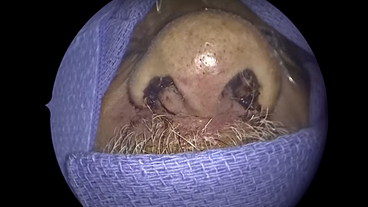
Carlson was shocked when he looked inside the man’s nose with a camera. He saw dozens and dozens of bugs feeding on the nose and sinus cavity ― some as big as the end of his pinkie.

“I knew he was in big trouble, there was erosion that was occurring near the skull base in very close proximity to his eye and his brain,” Carlson said.

At first, the physician tried using suction to remove the insects, which were in the larval stage. But they were too large, so he had to extract them one by one from the man’s nose.

“They were right up against his skull base, right under the brain, had they gone through that it could have killed him,” Carlson said.

The bugs have since been sent to an epidemiologist to determine their species. The patient is expected to make a full recovery.

It remains a mystery how the larvae got inside the man’s nose, but he told First Coast News that the problem might have stemmed from his bad hygiene habits when handling dead fish.

“Before I would rinse my hands in the river, now I’ll use cleaner to do a better job and not touch my nose or my hand,” the man told the station.

See the full story at First Coast News.


Source: https://www.huffpost.com/entry/florida-man-150-live-bugs-in-nose_n_65d52505e4b0b65d6920e19e ... and provided by video-cutter-online.com
There is new cut-trim tool cut-trim.com where you can cut-trim audio and video and convert mp3 to youtube cut-trim